
How the Five Rupee Ticket is Destroying a System

Published: November 23, 2025
Updated: August 19, 2026
Kerala’s Proud Legacy of Public Health
Kerala has long been celebrated as a model of public health excellence.
A network of government hospitals, accessible to even the poorest citizen, remains one of the State’s most progressive achievements. Every day, thousands receive consultations, investigations, and emergency care at a cost unmatched anywhere in India.
The intention behind this framework is noble and unambiguous — the Government wanted no citizen to be denied care.
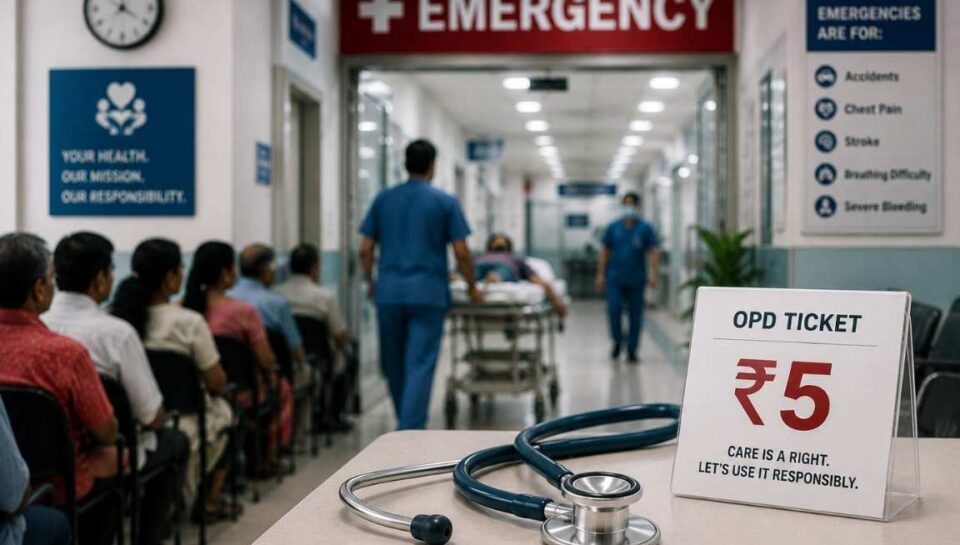
The five-rupee outpatient ticket symbolised this commitment to equity and compassion.
When Compassion Turns Counterproductive
Yet the same five-rupee ticket, introduced as an emblem of compassion, has now become the greatest threat to the very system it was meant to strengthen.
What was intended as a gateway to essential care has slowly transformed into a license for misuse.
The consequences are serious.
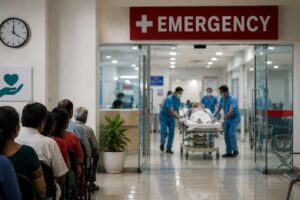
The casualty departments of government hospitals are collapsing under the weight of non-urgent crowds. Doctors are losing precious minutes that could save lives. Infrastructure built for emergencies is being consumed by avoidable footfall.
The Erosion of Medical Value
The five-rupee ticket has created an illusion in the minds of the public that medical time and medical expertise hold no real value.
The result is a behavioural shift in which people walk into hospitals at any hour of the day or night for trivial symptoms that carry no urgency.
Casualty departments see patients arriving at one o’clock in the morning for complaints such as mild fever, throat irritation, three-day abdominal discomfort, itching, or headache.
These are not emergencies by any stretch of the imagination.
Yet they flood the emergency room because there is no deterrent to doing so. This misuse of the public system has become habitual and unchecked.
When Emergency Departments Become OPDs
This distortion affects everyone.
When the casualty is inundated with non-urgent cases, the doctor cannot instantly identify the one person whose condition is deteriorating.
When a patient with a stroke or heart attack arrives, the team is already overwhelmed by a crowd that should never have been there.
The staff, exhausted by relentless nights of unnecessary consultations, struggle to maintain focus and composure.
The essential moral and emotional space required to deliver emergency care is eroded.
The five-rupee ticket, harmless on paper, creates chaos in practice through continuous misuse by the public.
The Triage Gap
At the heart of this crisis lies not only public misuse but also a systemic weakness — the lack of a clear and empowered triage protocol.
Many emergency departments still lack robust triage mechanisms that can confidently filter non-urgent cases at entry.
In the absence of standardised triage, even experienced staff are compelled to attend to all walk-ins, regardless of their urgency.
A major challenge is the deliberate misuse of the triage system by the public.
Many patients present at the casualty counter with exaggerated or fabricated symptoms solely to bypass waiting.
People claim sudden chest pain, severe breathlessness, blackout, or acute abdominal agony, only to disclose minutes later that their real concern is a common cold, a mild sore throat, or three days of itching.
Triage nurses are compelled to prioritise these claims because no emergency department can afford to ignore a complaint suggestive of a life-threatening condition.
The public knows this, and they exploit it without hesitation.
This conscious manipulation not only disrupts the flow of genuine emergencies but also creates an atmosphere of distrust and disorder in a space designed to save lives.
Properly enforced triage protocols, supported by signage, public awareness, and administrative backing, can prevent the misuse of emergency space.
A structured triage process is not just an administrative tool — it is the first line of defence against misuse of the public health system.
The Misinterpretation of Emergency Care
Emergency departments were created to manage time-sensitive, life-threatening conditions — road traffic accidents, chest pain suggestive of myocardial infarction, acute breathing difficulty, loss of consciousness, severe trauma, uncontrolled bleeding, and obstetric crises.
These cases cannot wait for morning outpatient clinics.
Their care demands immediate triage, rapid decision-making, and unobstructed access to equipment and skilled staff.
But when a casualty receives more than one hundred and fifty people a night for complaints that can easily wait until morning, the purpose of the department is defeated.
People arrive in groups, insisting on consultations for the common cold at midnight.
They demand immediate attention for minor ailments.
They argue about their turn.
They question triage decisions.
They treat the emergency room as an all-night extension of the outpatient department simply because the cost of entry is negligible.
This is the purest form of misuse.
A Habit of Misuse
This culture of misuse by the public is not a reflection of need but of habit.
The extremely low-ticket charge enables a pattern of healthcare consumerism that is careless, excessive, and deeply unfair to the staff who must function under relentless pressure.
A system built on taxpayers’ money cannot withstand such indiscriminate usage.
If a service is free or nearly free, it must be used responsibly.
That basic social discipline has collapsed under continuous misuse.
Finding the Solution
The solution begins with acknowledging this hard truth.
The problem is not with the Government.
The problem is not with the doctors who work far beyond their limits.
The problem lies with public behaviour that refuses to differentiate between urgency and convenience.
This behavioural error has reached a stage where it is damaging the very system built for the people.
It is misuse by the public, not neglect by the State, that is silently undermining emergency care.
Revisiting the Consultation Fee
One correct step is the revision of the casualty consultation fee.
A realistic fee, between fifty and one hundred rupees, would not burden any genuine patient.
Many already spend far more than that on transport, snacks, and phone recharges while visiting hospitals.
A modest increase in ticket price would act as a psychological filter or a deterrent.
It would make the public pause and consider whether their visit warrants immediate attention.
It would reduce unnecessary footfall and restore sanity to emergency departments.
This is not a punitive measure.
It is a protective measure necessary to preserve emergency care for those who require it most.
Public Education and Shared Responsibility
Alongside this, public education is vital.
Hospitals must display clear boards describing what constitutes an emergency.
Campaigns must emphasise that cough, cold, sore throat, mild fever, body ache, and long-standing non-critical symptoms are not emergencies.
A strengthened triage system must be empowered to direct non-urgent cases away from the casualty.
People must be reminded that the purpose of the emergency room is to protect lives, not to act as a midnight convenience clinic.
Only then can misuse by the public be curbed effectively.
The Way Forward
Kerala has built a health system that many states admire.
It is one of the finest legacies of public governance in India.
But no government, no doctor, and no emergency infrastructure can withstand continuous misuse.
The responsibility now rests with the public to elevate their conduct to match the quality of the system they have been given.
If the misuse by the public continues unchecked, the five-rupee ticket will become the silent saboteur of the health service.
But suppose citizens begin to exercise discipline, respect, and awareness. In that case, the emergency departments of Kerala can continue to remain what they were designed to be: safe havens for the critically ill.
Disclaimer
This article represents a professional and reformative reflection by a government medical officer, written with the sole intention of contributing to constructive public policy dialogue and improvement of healthcare delivery systems.
It is not intended as criticism of Government policy or administration, but as an appeal for behavioural reform and systemic strengthening within the framework of existing public health goals.
Opinions and suggestions are personal and do not constitute the positions of the Government of Kerala or the Department of Health Services.