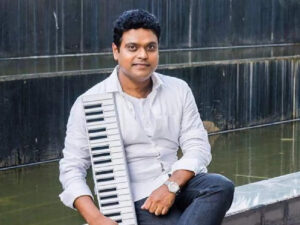

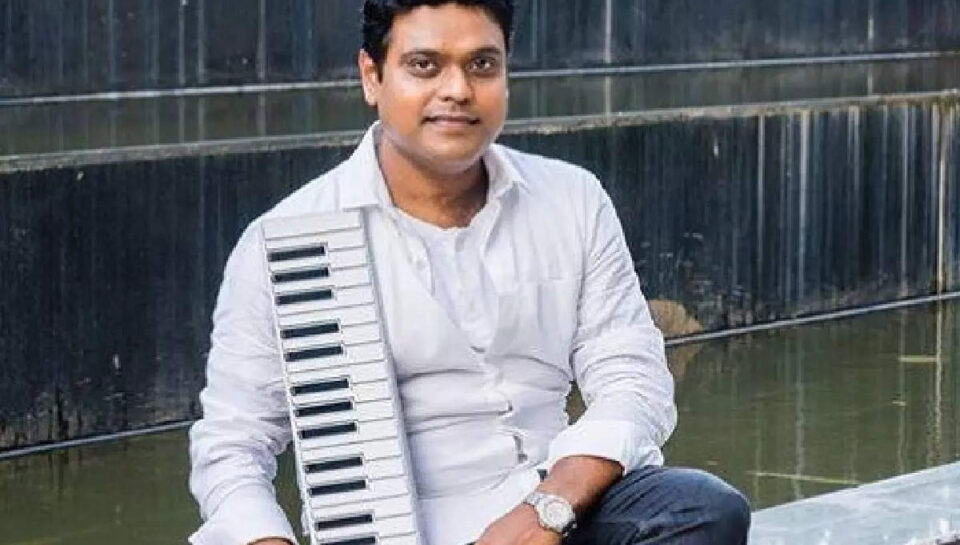
Harris Jayaraj – the undeservingly forgotten virtuoso

Published on October 25, 2023
Last Updated: October 26, 2023
Reading Time: 4 min
It was the year 2001.
I was preparing for my Pharmacology University theory examinations in a friend’s room at Men’s Hostel II, Government Medical College, Thiruvananthapuram, when I heard the song:
“Vaseegara En Nenjinikka Un Pon Madiyil Thoonginal Pothum…”
It was playing from the next room.
At a time when the Tamil and Hindi film music industry was overflowing with A. R. Rahman’s music—and when the air was filled with albums like Rhythm, Thenali, Kandukonden Kandukonden, and the critically acclaimed Alaipayuthey from the previous year—I naturally assumed this too was another A. R. Rahman composition. The music was simply too soothing and addictive to think otherwise.
I listened to the song in its entirety but could not investigate further because my examinations were only two days away, and I still had an enormous syllabus to complete.
The Arrival of a New Musical Era
After my examinations, I discovered that the album was not composed by A. R. Rahman.
Instead, it introduced a new composer to Tamil cinema—Harris Jayaraj, a music director who had previously worked as an audio engineer.
With just five songs in Minnale (2001), Harris Jayaraj instantly announced the arrival of a new musical force.
Minnale marked the beginning of a fresh era in Tamil film music, at a time when stalwarts like A. R. Rahman, Yuvan Shankar Raja, D. Imman, and Devi Sri Prasad were already firmly established.
Harris Jayaraj brought a refreshing sound to Tamil cinema by effortlessly blending Western musical arrangements with Tamil lyrics.
The years that followed witnessed the rise of a musical magician whose compositions sounded exceptional on virtually every audio system. Deep bass, crisp mid-tones, and immaculate recording quality became his signature.
Even on ordinary speakers, every musical layer remained distinctly audible.
Singers sounded noticeably more mellifluous under his direction, and he consistently delivered chartbusters that challenged even the mighty A. R. Rahman.
His recording quality was so extraordinary that he was soon celebrated as one of the greatest perfectionists in Tamil film music.
The Gautham Vasudev Menon Association
Director Gautham Vasudev Menon (GVM) provided Harris Jayaraj with his first major breakthrough through his directorial debut, Minnale (2001), featuring the unforgettable hit “Vaseegara.”
That successful collaboration eventually extended to seven GVM films.
The music of Kaakha Kaakha, Ghajini, and Vaaranam Aayiram soon became timeless classics with an enduring cult following across South India.
Over the years, Harris Jayaraj worked with nearly every major Tamil film director, with the notable exception of Mani Ratnam, who has remained loyal to A. R. Rahman throughout his career.
Veteran Malayalam filmmaker Priyadarshan used Harris Jayaraj’s music in Lesa Lesa, the Tamil remake of Summer in Bethlehem.
Director Shankar collaborated with him for Anniyan and Nanban when A. R. Rahman was occupied with other commitments.
His achievements include three Tamil Nadu State Film Awards for Best Music Director:
- Kaakha Kaakha (2003)
- Anniyan and Ghajini (2005)
- Ko (2011)
Among my personal favourites are:
- “Vellaikkara Mutha” (Chellame)
- “Aagaya Chooriyanai” (Samurai)
- “Ye Chilipi Kallalona” (Gharshana, Telugu), beautifully sung by Sreenivas.
The Perfectionist of Recording Quality
Harris Jayaraj’s orchestration is what truly separates him from almost every other music director, with A. R. Rahman being the only comparable exception.
In terms of recording perfection, I believe Harris often surpassed even A. R. Rahman.
Listening to the final mix of any Harris Jayaraj composition is a delight for anyone who appreciates acoustic precision and high-quality music production.
He later established The Studio H in Chennai, one of South India’s most technologically advanced music production studios.
The song “Helena” from Iru Mugan became the first track recorded there.
Remarkable Collaborations
His association with Udhayanidhi Stalin gave audiences memorable songs from:
- Oru Kal Oru Kannadi
- Idhu Kathirvelan Kadhal
- Nanbenda
- Gethu
His collaboration with Suriya produced unforgettable soundtracks for:
- Ayan
- Aadhavan
- 7aum Arivu
- Kaappaan
Each of these films featured songs that continue to enjoy immense popularity.
The soundtrack of Engeyum Kadhal was another major success.
His background score for Thuppakki remains one of the finest theme scores Tamil cinema has produced in recent decades.
His long collaboration with Padma Shri Jayashree Ramanathan (popularly known as Bombay Jayashri) resulted in fifteen original songs—from “Vaseegara” (Minnale) to “Maya Mayakkari” (The Legend).
Every one of those melodies stands as an example of exceptional recording craftsmanship.
An Unfortunate Hiatus
Following Kaappaan (2019), Harris Jayaraj composed music for only one film—The Legend (2022), starring businessman Saravanan of Saravana Stores, Chennai.
Although the commercial success of both films remains debatable, their music certainly enjoyed considerable popularity.
Many music lovers continue to feel that songs like “Mosalo Mosalu” and “Mayakkari” from The Legend would have become monumental hits had they appeared in a mainstream commercial film.
A Composer Still Waiting to Return
Harris Jayaraj is still young, with plenty of music left to offer.
Although he has occasionally faced criticism regarding plagiarism and the repeated use of the C major scale, his contribution to Tamil film music is undeniable.
His absence from mainstream Tamil cinema cannot simply be dismissed as a natural decline.
In my opinion, it is largely a consequence of the Tamil film industry’s overwhelming dependence on Anirudh Ravichander since 2013.
While Anirudh has undoubtedly enjoyed enormous popularity, I personally feel that only a few of his songs remain memorable once the excitement surrounding the film fades.
I would even argue that the overall quality of Tamil film music has declined from the standards established by legends like Ilaiyaraaja and, later, A. R. Rahman.
As far as I am concerned, there is no meaningful comparison between Anirudh and Harris Jayaraj.
Harris’ compositions are vastly superior, both musically and technically, and many of them continue to serve as reference material for students of professional music production.
Awaiting the Comeback
I genuinely look forward to Harris Jayaraj’s return.
At the same time, I sincerely hope he does not return through YouTube singles, Tamil short films, or, even worse, by shifting his focus to Malayalam cinema, as Vidyasagar eventually did after losing his footing in Tamil cinema.
I want Harris Jayaraj back where he truly belongs—mainstream Tamil cinema.
That is his domain.
That is where he once shone brilliantly.
Looking Ahead
Harris Jayaraj had Gautham Vasudev Menon’s Dhruva Natchathiram scheduled for release on 24 November 2023.
I sincerely hope its music and background score remind Tamil filmmakers—and audiences everywhere who love Tamil film songs—of what has been missing over the past several years.