

Protecting Emergency Care

Published: July 11, 2026
Updated: August 03, 2026
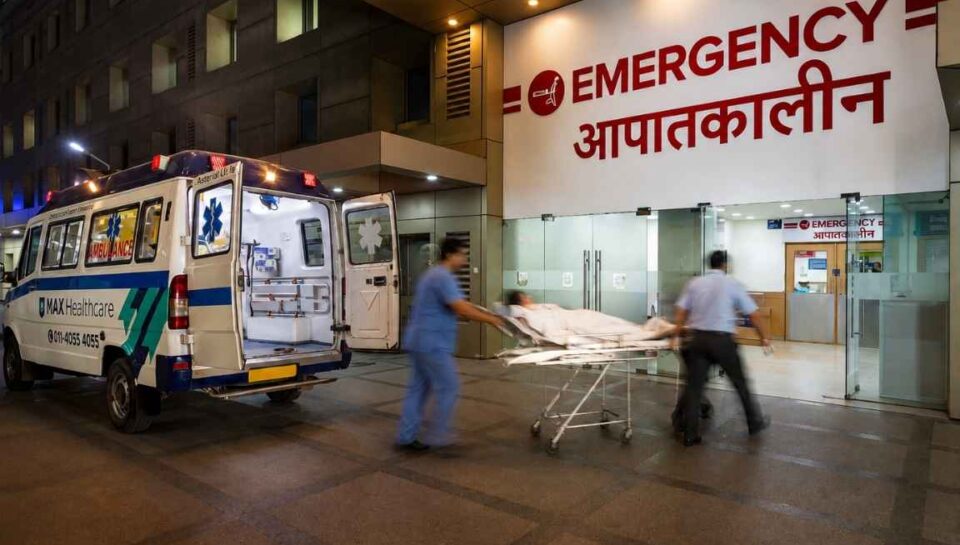
Why Kerala Needs Stricter Patient Control Centres Beyond Conventional Triage
A recent death in a government hospital has once again reignited usual questions about delays in emergency care. Inevitably, public attention has centred on identifying individuals who might be responsible. Though such an inquiry might be legitimate, they also divert attention from a far more fundamental question that receives remarkably little public discussion:
Why are our emergency departments so crowded that genuine emergencies must compete for attention in the first place?
Having spent many years in the public healthcare system, mainly in Casualty services, I have witnessed emergency departments becoming something that they were never meant to be.
Most emergency departments function as an extension of the OP beyond regular OP hours. Real emergencies arrive alongside colds, coughs, and three-day-old itches. Real emergencies having to jostle their way to the doctor through this crowd is the biggest challenge any healthcare institution in Kerala is facing now.
Evening has become more convenient for people to seek healthcare, and Casualty has become a one-stop shop for ECGs, X-rays, and necessary blood tests. This has gradually grown to be a matter of public expectation.
This is not a criticism of the public or any government mechanism, but rather a humble attempt to support the real intent behind government casualty services.
The real problem lies in the absence of clearly defined boundaries between emergency care and routine outpatient care.
Kerala has, over the years, built a healthcare infrastructure that is cheap, remarkably accessible and of superior quality to the rest of the country.
Though it is commendable, providing indefinite free access to such healthcare without deterrents would lead to overuse and misuse, as is seen in our hospitals, especially from 5 pm to 8 am the next day.
This conflation of easy access and the facility to demand any service round the clock – without any structural deterrents – is not sustainable in the long run.
Indefinite, unguarded, unrestricted access should not be the sole metric of a robust healthcare system.
Ultimately, a system must be judged by whether it preserves its ability to deliver effective care promptly to those people whose lives depend on it.
An institutional remedy that the administrative protocols reflexively rely upon after every mishap is to improve triage.
Though it may sound perfect on paper, the system is far less effective than it appears.
In my understanding, triage in its current form leaves it structurally vulnerable to volume-pressure.
The current triage system might have been successful when patient numbers were lower.
But the system of classifying people into Red, Yellow, and Green is not what we require now.
As people triaged into the green category would not like to wait for long, they devise means to convert themselves to red, and that is exactly how a mild headache may be described as the “worst headache ever,” gastritis becomes “acute chest pain,” and nasal congestion becomes “breathlessness,” or even a “complete nasal blockade”.
Whether such descriptions arise from anxiety, misunderstanding, or deliberate exaggeration is often impossible for the doctor or the triage nurse to determine immediately.
Another drawback of the current system is that the hapless triage nurses face immense pressure from patients demanding immediate access to the doctor, bypassing the queue.
Eventually, the doctor is mandated to attend to those “emergencies” only to find that they were not real.
When so many such pseudo-emergencies arise, doctors, nurses, and other support staff lose focus and eventually miss a real emergency that deserves real attention and time.
Those individuals who compete with real emergencies, thereby obscuring genuine emergencies by sheer patient volume, create situations that lead to tragic outcomes in many government hospital emergency departments.
Every unnecessary consultation consumes resources that should otherwise have been utilised by a patient with a real emergency.
It diverts the attention of doctors and nurses, utilises diagnostic equipment, occupies physical space, interrupts workflow and, above all, consumes a critical amount of time when a life could be saved.
Crowding disrupts the two basic requirements of emergency patient care – namely, astute concentration and quick decision-making.
When a doctor’s attention is clouded by a thousand non emergency cases, they are unable to spot the real life-or-death crisis waiting in the queue.
In more technical terms, it is clinical blindness caused by cognitive overload.
So, the ultimate loss is not the exhaustion of the healthcare provider, but a serious compromise on genuine patient care for the one presenting with a time-sensitive crisis.
The Patient Control Centre Model
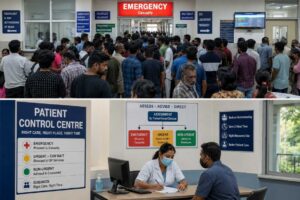
The solution, therefore, should move beyond improving conventional triage. Kerala should consider establishing Patient Control Centres in every Taluk Hospital, District Hospital, General Hospital and Medical College Hospital.
Positioned immediately outside the casualty department, these centres would become the true first point of clinical assessment. Their purpose would not be to deny healthcare. Rather, they would ensure that every individual is directed to the most appropriate level of care, whenever and wherever they are available, based on what they present with.
Under this gatekeeping model, patient influx is greatly controlled at the entrance. Patient Control Centres are meant to manage patient volumes and assess whether they are genuinely required to enter the emergency room.
Patients presenting with genuine emergencies would proceed directly to the casualty department for assessment and treatment.
Patients whose conditions can safely wait until the next outpatient session shall receive appropriate advice, be redirected to scheduled outpatient services, even if that is only the next morning, and shall not be allowed to access emergency services unless deemed necessary on a second-opinion, thereby reducing crowding in the emergency unit.
This system points towards an important philosophical shift.
Instead of asking, “Which patient should be seen first, a red, or a yellow, or a green?”, the healthcare system would first ask, “Does this patient require stepping into the emergency room at all?”
These are fundamentally different questions.
Conventional triage assumes that everyone entering the casualty department belongs there and merely determines who should receive priority.
A Patient Control Centre performs a more fundamental function by determining whether access to the emergency unit is required before the patient enters the emergency environment.
Only after that decision has been made should conventional emergency triage begin.
Such a model would substantially reduce unnecessary crowding, preserve emergency resources for genuinely critical cases, reduce cognitive overload among healthcare professionals, and improve the efficiency, safety, and responsiveness of emergency care.
Complementary Measures
Complementary measures should accompany this structural reform.
State-wide guidelines should clearly define what constitutes a medical emergency.
Public awareness campaigns should educate citizens on the appropriate use of emergency departments.
Outpatient services should also be restructured to reflect present-day lifestyles.
A significant proportion of evening casualty attendees are working individuals who are unable to seek care during conventional office hours.
Splitting general outpatient services – both specialist and general OPs into two sessions—for example, from 8am to 1pm and again from 4pm to 9pm —not with the existing workforce, but with the addition of extra workforce, would better accommodate this population while substantially reducing unnecessary migration into casualty departments after routine OP closure.
Controlled Access to Emergency Care
Just as access to public places is restricted in other systems, access to hospital emergency departments should be heavily controlled.
There should be structured access controls in place to prevent non-emergency people from flooding the unit and creating severe spatial congestion, thereby distracting healthcare workers from genuine cases that need attention.
Unlimited access is not the metric by which the quality of healthcare should be measured, as reflected in repeated instances where overcrowding has raised serious concerns about emergency patient care.
Understanding how our emergency services became so dangerously compromised is the critical question, and the root causes point more towards this unfiltered influx of non-emergency patients into the emergency room.
The ultimate objective is not to make healthcare less accessible. It is to ensure that emergency care remains immediately available for those whose conditions truly cannot wait.
The Next Frontier of Healthcare Reform
If our state wishes to preserve the remarkable achievements of its public healthcare system for future generations, it must begin thinking beyond affordability and accessibility.
The next frontier of healthcare reform is not merely universal access, but universal access to the right service, at the right place and at the right time.
Protecting government casualty services demands more than refining internal triage protocols.
It requires preventing unnecessary congestion before it reaches the emergency department.
The introduction of Patient Control Centres is a structural attempt to achieve exactly that.
Yet, despite whatever administrative regulations are put in place, the collective discipline, civic sense and self-awareness of the general public remain the ultimate defence against such chaos in the emergency room.
Only when the community understands and accepts that the casualty department is not meant to treat minor illnesses can it be preserved for its intended purpose.
Only when unnecessary crowding is effectively contained can genuine emergencies be managed with the speed, precision and undivided attention they desperately deserve.
Disclaimer
The views expressed are personal and intended to contribute to constructive discussion on public health policy. They do not represent the official position of any government department or institution.
The author is a medical doctor, writer and published translator of three books.
